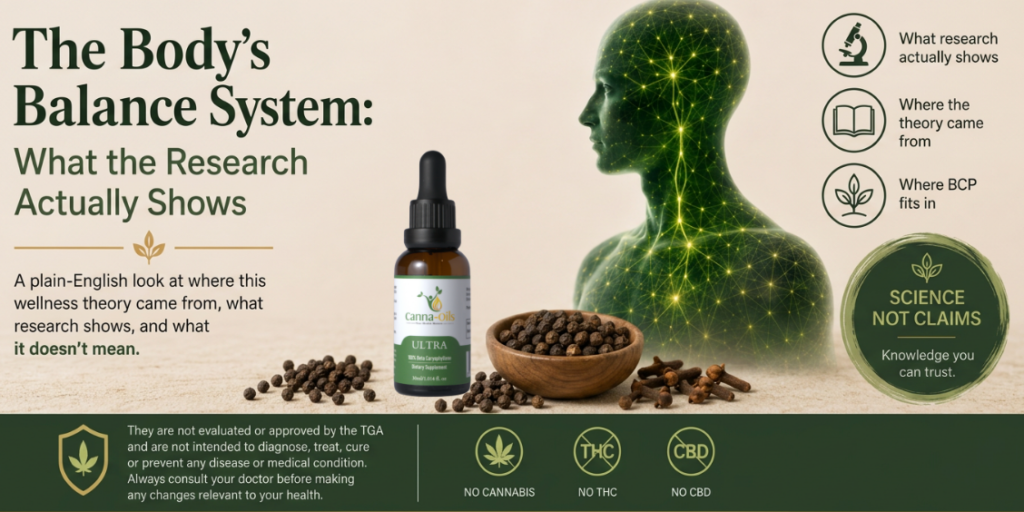
Hi again from the Canna Oils team. You may have come across the term “Clinical Endocannabinoid Deficiency” (or CECD) while reading up on the endocannabinoid system. It’s a genuine area of scientific interest, so I thought I’d put together a plain-English explainer on where the theory comes from, what researchers have actually found, and — just as importantly — what it doesn’t mean.
The Basics
What Is the Endocannabinoid System?
The endocannabinoid system (ECS) is a regulatory network found throughout the human body, first identified by researchers in the late 1980s. It’s now understood to be involved in everyday processes like mood, sleep, appetite and the body’s general sense of internal balance (sometimes called “homeostasis”).
The ECS relies on compounds the body produces naturally. It’s a normal, well-established part of human biology — it’s just less well known than systems like the digestive or nervous system, largely because it was identified more recently.
Where It Comes From
Where Does the “Deficiency” Theory Come From?
In 2001, researcher Dr Ethan Russo proposed that in some people, this system might not produce enough of its own regulatory compounds — an idea he termed “Clinical Endocannabinoid Deficiency”. He expanded on the theory in a follow-up paper in 2004, and revisited it again in 2016. It continues to attract academic interest today.
Important context
A hypothesis, not a diagnosis
It’s important to be upfront about what this is: a scientific hypothesis that some researchers continue to investigate, not an accepted medical diagnosis. It isn’t recognised as a diagnosable condition by Australian health authorities, and there’s no clinical test a doctor can currently order to confirm or rule it out. If you have an ongoing health concern, the right first step is always a conversation with your GP or another qualified healthcare professional — not a blog post (including this one).
The Ingredient
Where Does BCP Fit In?
Our products are built around beta-caryophyllene (BCP) — a naturally occurring terpene found in plants like cloves, black pepper, rosemary and cinnamon. BCP is one of the plant compounds that researchers studying the endocannabinoid system have taken an interest in, which is part of why it caught our attention as a botanical ingredient.
The Takeaway
The Takeaway
The endocannabinoid system is a real, actively researched part of human biology, and the CECD theory is a legitimate — if still unproven — area of scientific inquiry. But it remains exactly that: a theory. It’s not something we, or anyone else, can diagnose or treat with a blog post or a bottle of oil.
If you’re curious about the underlying science, Dr Russo’s original papers are publicly available and worth a read. And if you’re dealing with an ongoing health issue, please talk to your doctor.
To be clear
Canna Oils products are not registered therapeutic goods. They are not evaluated or approved by the Therapeutic Goods Administration (TGA), and they are not intended to diagnose, treat, cure or prevent any disease or medical condition. We make them because we love working with quality, naturally derived botanical ingredients — not because we’re claiming to fix a medical problem.
No cannabis, No THC, No CBD – Clove source. BCP is legally classified in Australia as a terpene.
Further Reading
- Russo EB (2004) — The original Clinical Endocannabinoid Deficiency hypothesis paper. Neuroendocrinology Letters — PubMed
- Russo EB (2016) — A follow-up paper revisiting the Clinical Endocannabinoid Deficiency hypothesis. Cannabis and Cannabinoid Research — PubMed
This article is general and educational in nature only. It is not medical advice and is not a substitute for advice from a qualified healthcare professional. Canna Oils products are cosmetic goods. They are not registered with the Therapeutic Goods Administration (TGA) and are not intended to diagnose, treat, cure or prevent any disease or medical condition. Always consult your doctor before making any changes relevant to your health.
Curious about BCP?
See what’s behind the oil
A naturally occurring terpene, quantified in every bottle.